KoBulChess.com announces memorial tourney on the occasion of GM Venelin Alaikov's 80th anniversary (born on 18.02.1933) in the following sections:
Section A: s#3-7 without any fairy pieces or conditions. Theme free.
Judge: Diyan Kostadinov
Section B: h#2-3 or hs#2-3 with fairy piece Andernach Grasshopper (AG). White, black, neutral AG are allowed, but other fairy pieces or conditions are not accepted.
Judge: Krassimir Gandev
Andernach Grasshopper - Like a normal Grasshopper (moves along Queen-lines over another unit of either colour to the square immediately beyond that unit) but it changes colour of the piece it jumps over (except the Kings and the neutral pieces).
Send to: Diyan Kostadinov
dkostadinov(AT)abv.bg
Closing date: 18.1.2013
Example:
|
Krassimir Gandev
Strate Gems 2011 |
 |
|
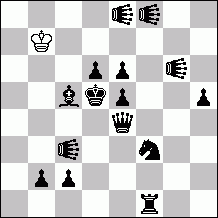
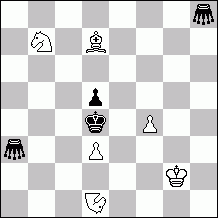
h2#
1+15
c3, e8, f8, g6 Andernach Grasshoppers |
|
1.AGa1(wPb2) b3 2.AGg8 (wAGf8) AGh8 (wAGg8)#
1.AGc1 (wPc2) c3 2.AGd8(wAGe8) AGc8 (wAGd8)# 1.AGc6(wBc5) Kb6 2.AGd8 (wAGe8) AGb5 (wAGc6)# 1.AGg3 (wSf3) Sd2 2.AGg7 (wAGg6) AGd3 (wQe4)# |
Jubilee tourney Milan Vukcevich - 75
To celebrate Milan’s 75th birthday, StrateGems is announcing a jubilee tourney in the following sections:
Section A - Twomovers, Judge: Vasyl Dyachuk
Section B - Threemovers, Judge: Robert Burger
Section C - Moremovers, Judge: Richard Becker
Section D - Helpmates, Judge: Dan Meinking
Section E - Selfmates, Judge: Petko A. Petkov
The theme for the tourney is free. A special consideration will be given to compositions which show one (or more) of Milan’s favorite themes: Reciprocal Change, Bristol, Novotny and Grimshaw.
Prizes in books and free subscriptions will be given to all prize winners. An electronic version (PDF) of StrateGems, with the tourney results, will be emailed to all tourney participants.
Send to: Mike Prcic Tuzlak(AT)aol.com
Closing date: 31.12.2012
Jubilee tourney Vladislav Buňka - 75

s5-6# - theme free
Judge: Vladislav Buňka
Send to: Jaroslav Karel, V Zápolí 1255, 141 00 Praha 4, Czech republic
75JT(AT)seznam.cz with note "75JT"
Closing date: 31.12.2012
Jubilee tourney Jaroslav Karel - 75
3# - theme free
Judge: Jaroslav Karel
Send to: Vladislav Buňka, Pod Barborou 31, 284 01 Kutná Hora, Czech republic
75JT(AT)seznam.cz with note "75JT"
Closing date: 31.12.2012
21th Memorial tourney Z. M. Birnov
2# - Judge: Valery Shanshin
3# - Judge: Aleksandr Bakharev
n# - Judge: Sergey Abramenko
studies - Judge: Alexej Sochnev
h2# - Judge: Aleksander Semenenko
Send to: rosinio(AT)mail.ru
Closing date: 30.11.2012
Jubilee tourney Abdelaziz Onkoud - 40

h2-4# - Theme. In one phase, a White piece A pins a Black piece C, while the White piece B is captured. In another phase, the White piece B pins the Black piece C on a different line, while the piece A is captured.
Judge: Abdelaziz Onkoud
Send to: Abdelaziz Onkoud , 08 François Villon , n° 2362, 93240 Stains, France.
azonkoud(AT)hotmail.com
Closing date: 30.11.2012
Examples:
|
Abdelaziz Onkoud
1.Kd6 Rc5 2.Kxc5 Se4#Pat a Mat 2010 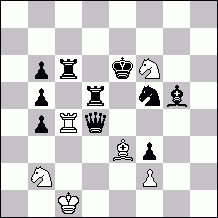 h#2 6+10 1.Ke5 Bf4+ 2.Kxf4 Sd3# |
Abdelaziz Onkoud
1.Sxb1 (1.Sb3?,1.Sc4?) Rxd4 MT Manne Persson 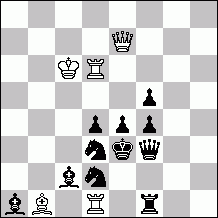 h#2 5+11 2.Kxd4 Qc5# 1.Bxd1 (1.Bb3?,1.Ba4+?) Qxe4+ 2.Kxe4 Re6# |
Abdelaziz Onkoud
1.Rxa2 (1.Re2?) c6+ Problem Observer 2011 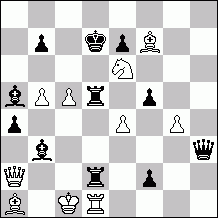 h#2 10+11 2.Kd6 e5# 1.Bxd1 (1.Bc2?) Be8+ 2.Kxe6 exf5# |
Abdelaziz Onkoud
1.Qxb5 Sg3+ 2.Kf4 e3#Diagrammes 2011 (v) 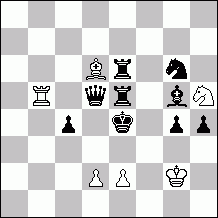 h#2 6+9 1.Qxd6 d3+ 2.Kf5 e4# |
Abdelaziz Onkoud
a)1.Sg3 Rxe3+ 2.Kxe3 Bxc7 JT Toma Garai 75 Commendation 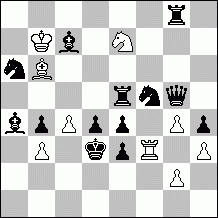 h#3 9+13 B: Se7 -> d8 3.Kf4 Sd5# b)1.Bd6 Bxd4 2.Kxd4 Rxf5 3.Kc5 Se6# |
Jubilee tourney 100 years Chessclub Ludwigshafen 1912
On the occasion of the 100th birthday of the Chessklub Ludwigshafen 1912 (to be celebrated on june 28th, 2012) an anniversary tourney for orthodox threemovers with free choice of theme is announced in his honour.
Prizes: 500 €
The awards will be published in a brochure which will be sent free of charge to all participants. Therefore composers should include their postal addresses on all diagrams.
Judges: Dr. Hermann Weißauer and Franz Pachl
Send to: Dr. Helmuth Morgenthaler, Borsigstr. 11, D-67063 Ludwigshafen, Germany
morgeh(AT)gmx.de
Closing date: 31.10.2012
Jubilee tourney Antonio Garofalo - 60

h2# - with 2 or more solutions and/or twins. Theme: two white pieces create a battery, where the rear piece is always the same.
Judge: Antonio Garofalo
Send to: Antonio Garofalo, via Collodi n. 13, 70124 Bari, Italy
perseus(AT)bestproblems.it
Closing date: 19.10.2012
Example:
|
Antonio Garofalo
Scacco 1992 1st Commendation |
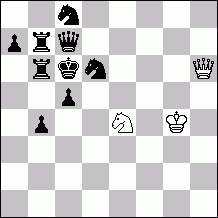
|
|
h2#
3+9
|
|
1.Rb5 Sxd6 2.Kb6 Sc4#
1.Rb8 Qh1 2.Kb7 Sxc5# |
Thematic tourney Julia´s fairies - HSP -2012
Rules: Help-self problems (HSP) of any possible types: Help-self mates (HS#), HS=, HS==, HR#, HR=, etc. in any number of moves.
Theme: Battery-play with fairy elements All pieces (white, black, neutral, half-neutral, etc) and conditions are allowed!
The thematic “Fairy element” (pieces, conditions) should be demonstrated in play at least in one battery or (plus) anti-battery of any type.
The problems should be computer-tested.
Judge: Petko A. Petkov
Send to: Julia Vysotska julia(AT)juliasfairies.com
Closing date: 15.10.2012
Examples:
|
Petko A. Petkov
The Macedonian Problemist 2003 2nd Honorable Mention |
Wilfried Seehofer
feenschach 2008 |
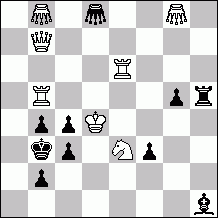
|
|
|
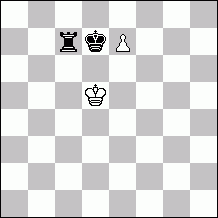
hs3#
7+10
|
hs4#
2+2
AntiCirce |
|
1.Rxg5 f2 2.Ra5 Bxb7
3.Re4+ Rd5# 1.Qxf3 g4 2.Qa8 Rxb5 3.Re5+ Bd5# Fairy elements: white direct battery created by Re6 (forward piece) and Gg8 (rear fairy-piece); black anti-batteries – Bd5/Gd8 and Rd5/Gd8. Any anti-battery is always thematic as “fairy element”. |
1.e8=R Rc8 2.Re1 Re8
3.Kd6 Kc6 4.Rb1+ Re1# Fairy element – creation and play of two Anti-Circe genre specific batteries (some authors call them Ecto-batteries) – white battery Re1/Kd6 and black battery Re8/Kc6. After play of Rooks (as forward pieces) two Kings are activated and give check (mate). A good example of fairy-battery which is created by orthodox pieces only, but which demonstrates fairy-element according to the rules of condition Anti-Circe! |
Jubilee tourney Aleksey Sochnev - 50

studies - theme free
Judge: Aleksey Sochnev
Send to: Jakov Rossomakho, Ordinarnaja 12, kv.29, 197136 Sankt Peterburg, Russia
yross(AT)mail.ru
Closing date: 1.10.2012
Jubilee tourney Zoltán Labai - 70
3# - theme free
Judge: Zoltán Labai
Send to: Ján Golha, Lúky 1231/89, 952 01 Vráble, Slovakia
goja(AT)goja.sk
Closing date: 1.10.2012
Jubilee tourney Hillel & Yoel Aloni - 75
The Israeli twin composers Hillel and Yoel Aloni will celebrate their 75th anniversary on September 30th 2012.
To commemorate this event and their immense contribution to the development of Israeli chess composition, the ICCS (Israeli association for chess composition) announces a formal composing tourney for twin endgame studies.
The thematic contents are free; however a twin-study is required, created by just one change in the initial position. More than two phases are allowed but a zero-position is forbidden.
Judges: Hillel & Yoel Aloni
Send to: Amatzia Avni, 9 Oranim st. Givaat-Shmuel 54052 Israel
avniam(AT)zahav.net.il
Closing date: 30.9.2012
Wola Gulowska - 2012
The Gen. Fr. Kleeberg’s Community Centre in Wola Gułowska announces the twentieth third formal competition on the following section:
2# - Judge: Leopold Szwedowski
3# - Judge: Jan Rusinek
s2# - Judge: Eugeniusz Iwanow
s3-4# - Judge: Waldemar Tura
h2# - Judge: Vladislav Nefjodov
Send to: Dom Kultury - Pomnik Czynu, Bojowego Kleeberczyków, 21-481 Wola Gulowska, Poland
wgdk(AT)interia.pl
Closing date: 30.9.2012
2nd International tourney Mini-Tour 2012
The Italian Problemistic Association (A.P.I.) organizing the 2nd International tourney Mini-Tour 2012.
They are allowed all kinds of problems with the following characteristics :
• Meredith form (maximum 12 pieces)
• Just 3 moves (no less, no more)
Each Author could send no more than 6 problems. It is guarantee the mailing of issue of the magazine and the Award.
The problems will be published on Sinfonie Scacchistiche I°-II°-III°-IV°/2012
Judge: to designate
Send to: valerio.agostini(AT)gmail.com
Closing date: 30.9.2012
9th International Chess Composing Tournament for 2011-12
The Italian Correspondence Chess Association (ASIGC) announce the 9th International Chess Composing Tournament for 2011-12
Original chess problems are requested for the following section:
2# - theme free – Judge: Marco Guida
h2# - theme free- Judge: Antonio Garofalo
No zero-position, no fairies. Originals will appear in Asigc : http://www.asigc.it and every composer will receive via email the justificative (Newsletter) and copy of award via email.
There will be prizes for the top three.
Send to: rallovito(AT)tin.it
Closing date: 30.9.2012
Jubilee tourney Enzo Minerva - 50
studies - theme free
Judge: Enzo Minerva
Send to: valerio.agostini(AT)gmail.com
Closing date: 16.9.2012
Jubilee tourney Terho Marlo - 50
Jubilee tourney Terho Marlo 50 for mate, selfmate ande helpmate problems (#, s# and h#) in 2-5 moves. The solution (the solutions in a helpmate) includes at least two mirror mates (ie. all 8 squares next to the mated King are vacant) on at least two different squares. The mirror mates may occur in different phases of the solution. (No need for model mates) No promoted pieces, no fairies, no zero positions.
Judge: Terho Marlo
Send to: Kenneth Solja, Hansatie 2 A 9, 02780 Espoo, Finland
kenneth.solja(AT)gmail.com
Closing date: 31.8.2012
Example:
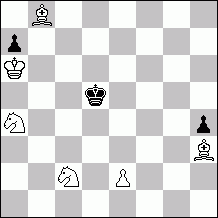 #2 6+3 1... Kc6 2.Sb4# 1... Ke4 2.Sc3# 1... Kc4 2.Be6# |
Tourney 150th anniversary of the Unity of Italy
The Italian Problemistic Association (A.P.I.) organizes an International Tourney of Composition for Helpmate in two moves in the occasion of the celebrations for 150th anniversary of the Unity of Italy.
Theme : “In a Helpmate in two moves a black piece X make an active interference (moving) to black piece Y in one solution, while in the other solution/solutions (or twin/twins) is the piece Y that moves, forcing the piece X to develop a passive interference”.
Practically it is the theme Argüelles applied to the helpmates.
This – perhaps – happened for the first time with the following problem (as example):
The originals will be published on Official Review of the A.P.I. (Sinfonie Scacchistiche) in the year 2012.
Every composer will receive the justificative and the award (always via e-mail).
Judge: Antonio Garofalo
Send to: valerio.agostini(AT)gmail.com
Closing date: 31.8.2012
Example:
|
Antonio Garofalo
1.d3 Qc5 2.Sg3 Qe3#Sinfonie Scacchistiche 1978 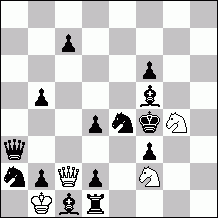 h#2 4+14 1.Qd3 Kxa2 2.Sg5 Qxc7# |
Jubilee tourney Nicolas Dupont - 50

Proof games showing echoes between black and white promoted pieces.
The term “echo” has to be taken in a broad sense, it means that something “similar” occurs between the black and white promotions. This echo can be of various types, e.g. between the natures of the involved pieces, the themes they performed, their moves, their final destination square (figurative echo), etc. The quality and the richness of those echoes will be my main criterion for ranking the entries.
Each entry can be orthodox or fairy, with only one fairy condition but no fairy piece allowed. Multi-solutions and twins are accepted.
Judge: Nicolas Dupont
Send to: Marquisfi(AT)wanadoo.fr
Closing date: 31.8.2012
Examples:
|
Michel CAILLAUD
dedicated to A. Frolkin and G. Wilts Europe Echecs 1994 |
|
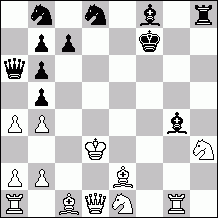
|
1.h4 e5 2.h5 e4 3.h6 e3 4.h×g7 h5 5.g4 h4 6.g5 h3 7.g6 h2 8.Sh3 Sh6 9.Rg1 h1=Q 10.g8=S Qc6 11.Sé7 Qc3 12.Sc6 d×c6 13.g7 Bg4 14.g8=Q f5 15.Qb3 Qdd3 16.Qb6 a×b6 17.d×c3 Ra4 18.Sd2 Da6 19.Sf3 e×f2+ 20.Kd2 Sf7 21.e4 Cd8 22.Be2 f1=R 23.Se1 Rf4 24.e5 Rfb4 25.e6 f4 26.e7 Kf7 27.e8=R f3 28.Re5 f2 29.Rb5 f1=S+ 30.Kd3 Sd2 31.c×b4 Sb3 32.c×b3 c×b5 33.b×a4 The thematic echo of this famous proof game is concentrated around promoted pieces’ natures and the themes they performed: three Ceriani-Frolkin by each side, each time with configuration (Q,R,S). |
|
proof game 32,5 12+11
|
|
|
Satoshi HASHIMOTO
Problem Paradise 2000 1st Prize |
|
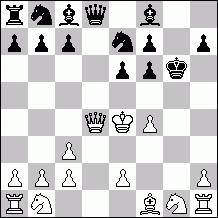
|
1.g4 e6 2.g5 Bb4 3.g6 Bc3 4.d×c3 Se7 5.Bg5 0-0 6.Bf6 g×f6 7.g7 d5 8.g×f8=B d4 9.Bh6 d3 10.Bc1 Kg7 11.Kd2 Kg6 12.Ke3 d2 13.Ke4 d×c1=B 14.Qd4 Bh6 15.f4 Bf8 Each side performs a Pronkin Bishop, hence two thematic echoes (same theme and same piece’s nature). Moreover the moves of the two promotions, Bf8-h6-c1 and Bc1-h6-f8, are in reverse order, hence showing a third, and deep, thematic echo. |
|
proof game 15,0 14+14
|
|
|
Unto HEINONEN
dedicated to M. Caillaud Probleemblad 2000 |
|
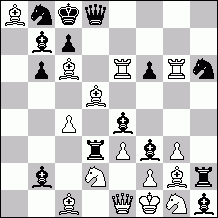
|
1.h4 a5 2.h5 a4 3.h6 a3 4.h×g7 a×b2 5.Rh6 Ra3 6.Rg6 h5 7.d4 h4 8.d5 h3 9.d6 h2 10.d×e7 d5 11.g3 d4 12.Bg2 d3 13.Kf1 d2 14.Qe1 d1=B 15.Sd2 b1=B 16.c4 Be4 17.e3 Rd3 18.a4 h1=B 19.a5 Rh2 20.a6 Sh6 21.g8=B Bg7 22.a7 Bb2 23.Raa6 f6 24.Bd5 Kd7 25.Re6 b6 26.a8=B Bb7 27.e8=B+ Kc8 28.Bec6 Bdf3 The thematic echoes concern here the nature of the promoted pieces (three Bishops by each side) together with their final destination squares (figurative echo). |
|
proof game 28,0 15+14
|
Thematic tourney Marianka 2012
Theme: Fairy problem using the fairy piece royal lion. Any stipulations are allowed, as well as any fairy conditions and/or other fairy pieces. Any twins, zero-positions, duplex, multiple solutions, tries or set play are allowed.
Definition: Royal lion is a piece with royal functions and lion mobility.
Judge: Juraj Lörinc
Send to: personally in Marianka to Juraj Lörinc or by e-mail to juraj.lorinc(AT)@gmail.com
Closing date: 4.8.2012, 21:00 for personal submissions in Marianka, 18:00 for e-mail submissions
Jubilee tourney „Pongracz Club“ - 20
Slovakian chess „Pongracz Club“ in ocasion 20th anniversary of its foundation organizes jubilee composing tourney in 2 sections:
2# - Judge: Emil Klemaníč
fairy with obligatory condition SAT (other fairy-elements optional) - Judge: Ladislav Salai jr.
(SAT - a king is checked if he can move according to orthodox resp. other given fairy rules of concrete composition)
Send to: Ľuboš Kekely, SK-023 32 Snežnica 128, Slovakia
kekely(AT)zmail.sk
Closing date: 3.8.2012
Jubilee tourney Kauko Virtanen - 80
h3# - featuring distant blocks.
Several parts and/or solutions are allowed, fairy problems nor zero positions are not allowed.
Judge: Kauko Virtanen
Send to: Kari Valtonen, Hämeenpuisto 17–19 B 23, FIN-33210 Tampere, Finland
chessproblem.valtonen(AT)gmail.com
Closing date: 31.7.2012
Jubilee tourney Gerhard Josten - 75

In May 2013 Gerhard Josten will celebrate his 75th birthday. For this reason the Jubilarian, in cooperation with the magazine "Die Schwalbe", announces a thematic tourney for endgame studies.
Theme: Required are studies with elements of surprise or mysteriousness on some moves with the additional conditions that during the first ten moves White is neither allowed to capture any black pieces nor to deliver check more than twice. Furthermore, in the starting position at least eight pieces are required.
Judge: Gerhard Josten
Please send your originals (maximum three per author) to the tourney director Siegfried Hornecker. The contributions have to be submitted as PGN files via email.
Prize funds: The Jubilarian offers three prizes at a value of 150 EUR, 100 EUR and 50 EUR. The payment is only possibe per bank transfer.
Prize report: The preprint is planned for February 2013 in "Die Schwalbe". The final judgement will be published at the same place in the issue of June 2013.
Send to: sh_etjoedy(AT)gmx.eu
Closing date: 31.7.2012
Examples:
|
Gerhard Josten
Die Schwalbe 6/2009 |
|
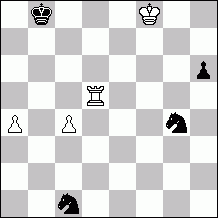
|
1.Rb5+ Ka7 2.c5 Se5 3.Ke7 Scd3 4.Kd6 Nf7+ 5.Ke6 Sfe5 6.Kd5 Sf7 7.c6 Sf4+ 8.Ke4 Se6 9.Rb7+ Ka6 10.Re7! Kb6 11.a5+!! Kc5 12.Ke3!! Sfd8 13.a6 Kd6 14.a7 Kxe7 15.a8Q Kd6 16.c7!! Kxc7 17.Qd5 Sg5 18.Kd4 Sc6+ 19.Kc5 +- |
|
win 4+4
|
|
|
Gerhard Josten
Magyar Sakkvilag 12/2010 |
|
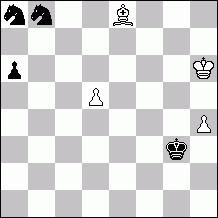
|
1.h5 Sc7 2.Bf7!! Sxd5 3.Kg7!! Se7 4.Be6 Sbc6 5.h6 Sd4 6.Kf7 Sg6 7.Bc8!! Se5+ 8.Kf6 Sdf3 9.Be6 Kf4 10.h7 Sg5 11.h8Q Se4+ 12.Kg7 win |
|
win 4+4
|
30th day tourney Festival Cup Marianka 2012
Theme: Fairy twomover with at least two phases. In one phase the threat A as well as defence a are to the same square (defence motif: disabling of the move by blocking), in the other phase the move a allows the move A in the function of the variation mate. Further content is free. Resp.:Fairy twomover with at least one threat paradox (Dombrovskis paradox, paradox D), in which the defence motif is the disabling of the move by blocking. The tourney is open only for participants of the festival, the winner would be award the Festival Cup Marianka 2012.
Judge: Juraj Brabec
Send to: brabec(AT)brabec.sk
Closing date: 30.7.2012
Example:
|
Juraj Brabec
1.LEd5 ? (2.LEf5# A, LEh3# B)
1... Sc5 ! cŠachové umění 2012 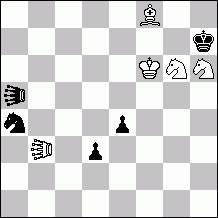 #2 5+5 1.LEe6 ? (2.LEf5# A) 1... Sc5 c 2.LEh3# C 1... LEf5 ! a 1.LEd1 ? (2.LEh5# B) 1... Sc5 c 2.LEh1# D 1... LEh5 ! b 1.LEf7 ! (2.Bg7#) 1... LEf5 a 2.LExf5# A 1... LEh5 b 2.LExh5# B |
Memorial tourney Anatoliy Zinchuk -75
Chess Composition committee of Ukraine and the editors of “Problemist Of Ukraine” magazine announce the composing tourney “MT Anatoliy Zinchuk - 75” dedicated to 75th birthday of the famous Ukrainian endgame and studies composer, ex-chairman of the Chess Composition committee of Ukraine - Anatoliy Zinchuk at two sections:
endgame and studies - theme free
Judge: Vladimir Pogorelov
hn# - theme free
Judge: Yuri Gordian. Prize fund - 300€
Send to: Vladimir Pogoryelov, Str. Kagamlyka 80, 36008 Poltava, Ukraine
pogorelov58(AT)mail.ru
Send to: Yuri Gordian, PO box 66, 65026 Odessa-26, Ukraine
gordian37(AT)mail.ru
Closing date: 1.7.2012
3rd Memorial tourney Vladimir Archakov
h3# - Judge: Anatoly Styopochkin
s3# - Judge: Aleksandr Azhusin
Send to: rosinio(AT)mail.ru
Closing date: 1.7.2012
Jubille tourney Petro Novitsky - 60

The commission for chess composition of the Chess Federation of Ukraine and the magazine The Problemist of Ukraine announce an international #2 composing tourney to mark the 60th birthday of Ukrainian chess composer Petro Andriyovych Novitsky (born 22.07.1952); in two sections:
1. free theme
2. cycle of double threats with changed mates in response to one defense in each phase.
Judge: Petro Novitsky
All participants will receive a booklet with the tourney results and the jubilarian’s problems.
Send to: Petro Novitsky, 1, Lesia Ukrainka St., v. Rubchenky, Volodarsky rayon, Kyiv region, 09313 Ukraine
or v.dyachuk(AT)i.ua
Closing date: 1.7.2012
Jubilee tourney Kenneth Solja - 55

Helpmates in three or more moves with setplay or duplex and at least two solutions, no set theme.
No zeropositions, or promoted or fairy pieces.
Judge: Kenneth Solja
Send to: Rolf Uppström, Godhemsgatan 24 C, SE-41468 Göteborg, Sweden
rolf.uppstrom@springaren.se
Closing date: 30.6.2012
Jubilee tourney Jan Timman - 60

New In Chess announces a composition tourney to commemorate the 60th birthday of Jan Timman, grandmaster and author of The Art of the Endgame and several other fine books on endgame studies
studies - theme free. Twins and/or joint studies allowed.
Judge: Jan Timman
First prize: 300€, Second prize: 200€, Third prize: 100€. Also book prizes, honourable mentions and commendations will be awarded
Entries should include the name of the composer(s), postal address, diagram with full solution (preferably with a PGN-file attached)
Send to : René Olthof, c/o New In Chess, P.O. Box 1093, NL 1810 KB Alkmaar, The Netherlands
raja(AT)newinchess.com
Closing date: 30.6.2012
Munich helpmate tourney 2012
h#=>2,5 - Theme: Zajic theme according to the following definition:
A black or white piece moves to an actual or prospective square adjacent to his king and gets captured there; later the king captures the capturing piece on the same square. No fairy elements allowed.
Judge: Wilfried Neef
Send to: Wilfried Neef, Trollingerweg 18, D-89075 Ulm, Germany
munich-tourney(AT)web.de
Closing date: 30.6.2012
Examples:
|
J. Lois & M. Kapros
1.Qe7 Se3 2.fxe3 Kxe3Maroc Echecs 2011 4th Prize 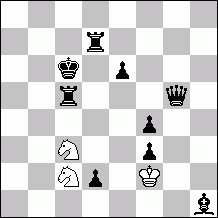 h#4 3+9 3.Kd6 Kd4 4.Rc6 Sb5# 1.Rd6 Se2 2. fxe2 Kxe2 3.Kd5 Kd3 4.Qe5 Sb4# white Zajic-theme |
W. Neef
1. … Bb4 2.Sxb4 Kxb4Marianka 2010 (v) nd Commendation 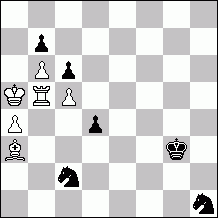 h#5 6+6 3.Kf2 Kc4 4.Ke1 Kd3 5.Kd1 Tb1# white Zajic in a moremover |
C. Jones
1.Rf6 Rg2 2.Kxe6 gxf6Wageningen 2006 (?) 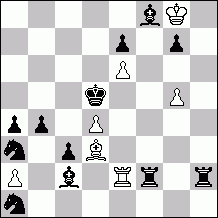 h#3 7+12 3.Kxf6 Rg6# 1.Bb3 Bb1 2.Kc4 axb3+ 3.Kxb3 Ba2# interrupted black Zajic |
2nd tourney Maroc Echecs 2012
2# - theme free - Judge: Mohamed Jamal Elbaz
3# - theme free - Judge: Alexander Sygurov
n# - theme free - Judge: Martin Hoffmann
studies - theme free - Judge: Mourad Métioui
h2# - theme free - Judge: Pierre Tritten
h2,5-3# - theme free - Judge: Vadim Vinokurov
h3,5-7# - theme free - Judge: Kenneth Solja
Send to : Abdelaziz Onkoud , 08 François Villon , n° 2362, 93240 Stains, France
azonkoud(AT)hotmail.com
Closing date: 30.6.2012
Tourney Csák - Majoros - Pásztor - 2012 (Jubilee tourney Zoltán Labai - 70)
On the occasion of the 70th birthday of the International chess-problem composer master Zoltán Labai, a tourney will be held in the following sections.
s5-10# - theme free
Judge: József Pásztor
h3# - theme free
Judge: János Csák
Send to: Béla Majoros, Kossuth ut. 8, Bakonyoszlop, H-8418 Hungary
bmajoros55(AT)gmail.com
Closing date: 30.6.2012
Jubilee tourney SOKŠ - 60

On the occasion of its 60th anniversary, the Slovak Organization of Chess Composition (SOKŠ) announces an international composing tourney for orthodox twomovers (theme free).
Judge: Vasyl Dyachuk
Send to: Ján Golha, Lúky 1231/89, 952 01 Vráble, Slovakia
goja(AT)goja.sk
Closing date: 28.6.2012
Memorial tourney Jindřich Fritz - 100
To celebrate the centenary of Jindřich Fritz (15.6.1912 – 9.11.1984), Šachový svaz ČR (Chess Federation of the Czech Republic), Sdružení šachových problémistů (Association of Czech Problemists) and Československý šach Magazine announce an international anonymous composing tourney for endgame studies.
studies - theme free, but the judge is ready to award special distinctions to development of Fritz ideas.
Judge: Jaroslav Polášek
Not more then 3 studies per composer
Running information, list of entries and award will be available on the web www.vlasak.biz/fritz100.htm. The award will be also published in Československý šach.
Send to: Emil Vlasák, Stavbařů 3, 400 11 Ústí nad Labem, Czech Republic)
emil(AT)vlasak.biz
Closing date: 15.6.2012
Jubilee tourney Bedrich Formánek - 79

On the occasion of WFCC Honorary President Bedrich Formánek´s 79th birthday (* 6th June 1933), the Slovak Organization of Chess Composition (SOKŠ) announces an international composing tourney for helpmates in 2 or 3 moves fulfilling the rules of Pressburger chess (Bratislava chess). No other conditions or fairy units are allowed. The best compositions will be awarded prizes, honourable mentions and commendations. The winning composers will receive older issues of FIDE Albums, the book Slovenský výber II or other books about chess composition. The award will be published on the SOKŠ website www.soks.host.sk, as well as in the magazine PAT A MAT, the issue will then be sent to all participants.
Judge: Bedrich Formánek
Send to: Juraj Lörinc, Pažítkova 5, 821 01 Bratislava, Slovakia
juraj.lorinc(AT)gmail.com
Closing date: 6.6.2012
The rules of Pressburger chess:
1. The king may stand in check unless it is mated. (Capture of a king is not allowed.)
2. Mate is a check that cannot be parried by the following move, i.e when there is no move available to parry the check.
3. Kings cannot stand on adjacent squares unless one of them is mated (point 4).
4. Mate by a king is allowed only if the square of the king giving mate is guarded by a unit of the same colour as the king and not guarded by a unit of the opposite colour (with the exception of the king; in the case of double check guarding by a unit of the opposite colour is allowed).
5. Otherwise the rules of orthodox chess are valid.
(Pressburg was the name of Bratislava until 1919.)
|
Bedrich Formánek
a)Feenschach 1-2 1966 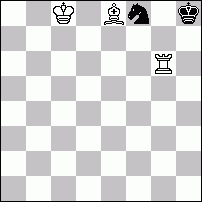 h#2* 3+2 a) orthodox chess b) Se8->h5 Pressburger chess 2.1.1.1 1…  f7 2. f7 2. h7 h7  g8# g8#1. e6 f7 2.g7 h6#b) 1… g8 2.h7 f7#1. e6 h6 2.g7 f7#1.  g7 g7  d7 2.f6 e6# d7 2.f6 e6# |
Bedrich Formánek
1… h3 2.7604 Feenschach 1-2.1966 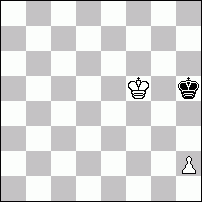 h#2* 2+1 Pressburger chess 2.1.1.1 h4 g4#1. h4 f4 2.h3 g3#1. h6 h4 2.h5 g5#
|
Bedrich Formánek
1.370v Feenschach 4-6.2010 (opr.370 Feenschach 11.1971) 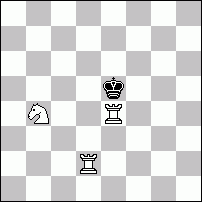 h#2* 3+1 Pressburger chess 2.1.1.1 d4  d5 2.d3 d4# d5 2.d3 d4#1. d5 c2 2.d4 c4#
|
Bedrich Formánek
1.10148 Šachová skladba 4.2010 (opr.7605 Feenschach 1-2.1966) 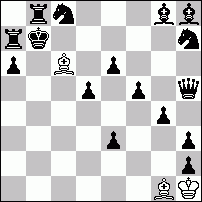 h#3 3+16 Pressburger chess  d4 :h2 2.b6 g1 d4 :h2 2.b6 g1 3.d4 h1#1. e5? :h2 2.c7 :d5 3.e2 h1??
|
Memorial tourney Svjatoslav Fjodorov - 85
3# - theme free - Judge: Mikhail Marandyuk
h3# - theme free - Judge: Mikola Gershinskyi
s2-10# - theme free - Judge: Petko Petkov
Send to: Vadim Vinokurov vkv-53(AT)yandex.ru
Closing date: 1.6.2012
Jubilee tourney Wouter J.G.Mees - 90
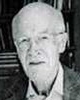
On the occasion of the 90th birthday (6.8.2011) of Wouter J.G.Mees, the Dutch Chess Problem Society (Netherlandse Bond van Schaakproblemvrieden – NVvS) and ARVES jointly organized a chess composition tourney. Therefore, this tourney’s theme is a logical ult. The ult stipulation was invented by Moravec and Mandler, and translates as ‘White to win in n moves’.
Judges: Wouter Mess & Harold van der Heijden
Maximum of 3 per composer
Book prizes (problems, endgame studies). The award will be published in “Problemblad”.
Send to: Henk Le Grand, Heimanslaan 5, NL-6705 AD Wageningen, the Netherlands
h.le.grand(AT)xs4all.nl
Closing date: 1.6.2012
Example:
|
British Chess Magazine, 1931
|
|
|
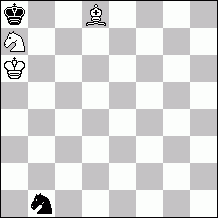
1.Sc8! Kb8 2.Sb6 Sa3 (2...Sd2 3.Bg5! Se4 4.Bf4+ Sd6 5.Bxd6# ; 2...Sc3 3.Bf6!) 3.Be7! Sc2 4.Bd6# |
|
ult in 5 3+2
|
Jubilee tourney Nikola Stolev - 65
The Editors of Orbit announce a formal tournament for the 65th birthday of our Editor Nikola Stolev.
h#3 - theme free. No zeropositions, duplex, or promoted or fairy pieces.
Judge: Nikola Stolev
The results will be published in Orbit before the end of 2012.
Send to: Živko Janevski, P.Box 163, 1480 Gevgelija, Macedonia
zivko(AT)t-home.mk
Closing date: 31.5.2012
Jubilee tourney Tode Ilievski - 60

The Editors of Orbit announce a formal tournament for the 60th birthday of our regular collaborator Tode Ilievski.
hn#, n>=3,5 - theme free. No zeropositions, duplex, or promoted or fairy pieces.
Judges: Nikola Stolev & Živko Janevski
The results will be published in Orbit before the end of 2012.
Send to: Gligor Denkovski, ul. Dame Gruev br. 7/4-16, MK-1000 Skopje, Macedonia.
denkovski(AT)t-home.mk
Closing date: 31.5.2012
Jubilee tourney Nikola Petkovski - 65
The Editors of Orbit announce a formal tournament for the 65th birthday of Macedonian problemist Nikola Petkovski.
h2# - theme free. No zeropositions, duplex, or promoted or fairy pieces.
Judge: Živko Janevski
The results will be published in Orbit before the end of 2012.
Send to: Nikola Stolev, Bukovic 3a, n.Lisiče 1000 Skopje; Macedonia
stolev(AT)t-home.mk
Closing date: 31.5.2012
Jubilee tourney Iuri Akobia - 75
The Commission of Chess Composition of Georgia announces a anonymous composition tourney (studies) to commemorate the 75th birthday of Iuri Akobia.
The competition has two sections:
1. Theme free
2. Rook studies with some quiet moves.
Twin studies not allowed (in both section).
Judge: Iuri Akobia
Entries should be with the name of the composer(s), diagram and solution (formats:PGN, DOC, PDF etc.)
Send to: Mario Guido Garcia marioggarcia(AT)gmail.com
Closing date: 20.5.2012
Olympic Chess Composing Tourney 2012
The International Chess Federation (FIDE) within the framework of its "Chess Composition" special project and in co-operation with the Turkish Chess Federation announce an Olympic chess composing tourney in 8 sections, dedicated to the World Chess Olympiad 2012 in Istanbul. The tournament is co-ordinated with the WFCC Presidium and is a part of the joint efforts by FIDE and WFCC for the popularization and development of chess composition worldwide.
The tournament sections and judges are as follows:
2# - Judge: Anatoly Vasilenko
3# - Judge: Miodrag Mladenović
n# - Judge: Yakov Vladimirov
studies - Judge: Oleg Pervakov
h# - Judge: Nikola Stolev
s# - Judge: Diyan Kostadinov
Fairies - Judge: Juraj Lörinc
Retros and Proofgames - Judge: Bernd Graefrath
In each section, only one composition from each author is acceptable; joint compositions are not allowed.
The themes are free in all sections, and any number of moves is acceptable in the h#, s#, fairies and retros sections. In the fairies section only problems computer-tested by one of the programs Alybadix, Popeye or WinChloe are allowed; the participants should mention the program they have used for testing their composition.
The director of the tournament is IGM Petko A. Petkov (FIDE international judge), who will not participate as author or judge in the tournament.
Entries (preferably in WORD format, but other formats are also acceptable)
The director will send all compositions to the judges on standardized anonymous diagrams by May 15th, 2012.
All the judges should prepare their awards by July 15th, 2012. The results will be published on the Internet by August 1st, 2012 and they will be declared final after two months allowed for claims of anticipation and unsoundness.
The best compositions in each section will be awarded with prizes, honourable mentions and commendations, as well as FIDE certificates and Olympic medals. All participants will receive a copy of the booklet with the final awards.
Send to: ppetkow(AT)mail.orbitel.bg
Closing date: 1.5.2012
Jubilee tourney Klaus Wenda - 70
feenschach is organising, as its 64th theme tourney, the Klaus Wenda 70 Jubilee tourney.
Required are strategic problems with the stipulation mate or selfmate in 4-10 moves, on the normal 8x8 board, using at least one fairy piece or condition which plays a thematic part in the problem. Neutral or half-neutral pieces (even if otherwise orthodox) are acceptable as this fairy element. Fairy pieces or conditions are allowed only if they are testable by at least one of the computer programs Alybadix, Popeye or WinChloe.
Dr. Wenda is offering four book prizes.
The complete tourney award will appear in feenschach in 2012. Every tourney participant will receive a copy of the relevant issue.
Judge: Hans Peter Rehm
Send to: Klaus Wenda, Rasumofskygasse 28, A-1030 Wien, Austria
klaus.wenda(AT)chello.at
Closing date: 1.5.2012
Tourney Gravure - 2012
2#, 3#, n#, h2#, h2,5-3#, h3,5-6#, s3-15# - theme free, maximum 8-10 pieces
Judge: Igor Agapov
Send to: 64(AT)avanta18.ru
Closing date: 30.4.2012
Memorial tourney Omri Admoni
The Israeli Chess Composition Society is announcing a composition tourney in the memory of one of its young composers who passed away recently.
Themes: Required are serial helpmates or Parry series helpmates (see below) in any number of moves. During the solution a black piece is pinned and this pin is utilized. The use of grasshoppers and nightriders, two pieces used by Omri in his recent compositions, is allowed but not any other fairy pieces or conditions. Multiple solutions and twins are also allowed. All entries must be computer checked.
In Parry series helpmates (invented by Dan Meinking) the series-side may give check during the series and the idle-side, when checked, must immediately parry the threat. After a check-and-parry, the series-side continues the series. Parry series helpmates can be checked in Popeye (V4.55), directly or through Fancy, using the stipulation pser-H#n.
Judge: Paz Einat
Send to: Shaul Shamir, Dror 3 Str., Rishon Lezion 75305, Israel.
yanivbenor(AT)yahoo.com
Closing date: 30.4.2012
Examples:
|
Arno Tungler
1.Ke6 2.Se4 3.S2g3 4.Ke5 Die Schwalbe 1978 3rd Prize 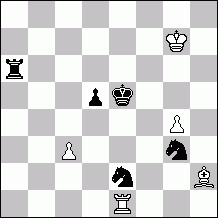 ser-h#5 5+5 5.Re6 Bxg3# 1.Kd6 2.Sf4 3.Sge2 4.Ke5 5.Rd6 Rxe2# |
Jorge J. Lois
a)37th TT feenschach 1978 3rd Prize 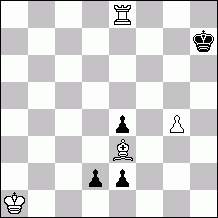 ser-h#8 4+4 B: Pg4 -> f6 1.d1=B 2.e1=Q 3.Qg3 4.Bxg4 5.Bf5 6.Qg8 7.Kh8 8.Bh7 Bd4# b) 1.d1=S 2.e1=R 3.Rg1 4.Rg6 5.Sf2 6.Sh3 7.Sg5 8.Kh6 Rh8# |
Ricardo M. Vieira
1.Qb7 2.Rg2+ Kxh3 GCQCT 2010 4th Prize 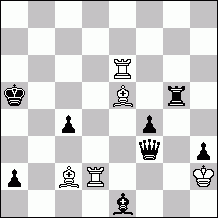 pser-h#4 5+8 3.Qb3+ Bc3+ 4.Qb4 Rd5# 1.Qb3 2.Bg3+ Kh1 3.Qb7+ Rd5+ 4.Qb5 Bc3# |
Jubilee tourney Gennady Chumakov - 70

h2#, h3# hn# - theme free
Judge: Aleksandr Semenenko
Send to: Gennady Chumakov, 170100 Tver, P.O. Box 9, Russia
chessproblem(AT)mail.ru
Closing date: 9.4.2012
Tourney 8th ECSC Kyiv
h3-n# - Theme: At a helpmate problem the White can mate at one move (#1). The presence of mates to the black King multitude with any intermediate solution length particularly H#2½ or H#3½ like at examples 3 - is not allowed.
Judge: Yuri Belokon
Send to: jvb579(AT)meta.ua
s3# - Theme (Self Thema Future): There are at least two play systems with different tactical, geometric, etc moments at a solution (the theme of the present?) Judge: Gennady Kozyura
Send to: v.kopyl(AT)i.ua
Closing date: 5.4.2012
Examples:
|
Tivadar Kardos
1.Rxb1#Raketa 1944 1st Prize 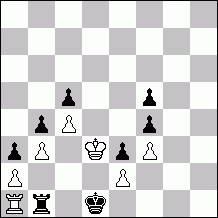 h#4* 7+8 1.Rc1 Rb1 2.Ke1 Rb2 3.Rxc4 bxc4 4.Kd1 Rb1# |
Michail Sosedkin
1.Sb6#IMR 1984 1st Prize 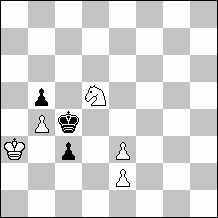 h#4* 5+3 1.c2 Kb2 2.c1B+ Ka2 3.Bd2 Ka3 4.Ec3 Sb6# 1.Ka2 2.c1S+ Kb2 3.Sa2 Ka3 4.Sc3 Sb6# |
Chris Feather
1.Sh6#, 1.Sxe5#Problemist of Ukraine 2009 Prize 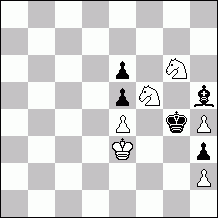 h#4** 6+5 1.exf5 Sxe5 2.Kxh4 Sg4 3.fxg4 Kf4 4.g3 hxg3# h#2,5 1.Sge7 2.B~ Cg8(d5,c6) 3.B~(Bh5) Sf6(Sxe5)# |
|
Valery Kopyl
A) 1.Rc1 (2.Qxb3+ Kd4 Gennady Kozyura Wola Gulovska 2011 3rd Prize 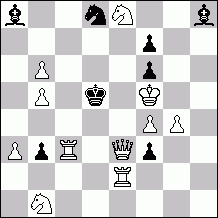 s#3 11+8 3.Re4+ Bx:e4#) +... fxe2 2.Qf3+ Kd4 3.Qe4+ Bxe4# B) 1... Sb7 2.Sc3+ Kc4 3.Sd6+ Sxd6# 1... Sc6 2.Sc7+ Kd6 3.Qd4+ Sxd4# A) The threat and the variation are united by the geometric bounce of the white queen and the piece sacrifice at e4 B) Two variations with the creation of an indirect battery and a black knight. |
Gennady Kozyura
1.Sf8 (2.Qf6+ Ke4+ Valery Kopyl Euxinus Pontus 2008-2009 Prize 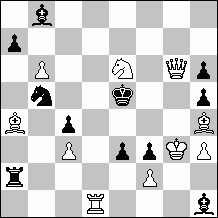 s#3 10+11 3.Qf4+ Bxf4#) A) 1... Sc7 2.Qd6+ Kf5(e4) 3.Qd5+, Sxd5# 1... Sd6 2.Rd5+ Kxd5 3.Qf5+, Sxf5# B) 1... Sd4 2.Qe4+ Kd6 3.Qd5+ Kxd5# 1... Rd2 2.Qf5+ Kd6 3.Qc5+ Kxc5# A) Battery S-L is being created which is mating B) The Black overlap Td1 and battery K-L is mating |
Ivan Soroka
A) 1.Bg5 (2.Re5+ Kxe5 Ural Problemist 2007 2nd Prize 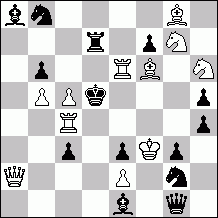 h#4** 6+5 3.Rcxe4 Bxe4#) 1... bxc5 2.Rd4+ Kxd4 3.Rexe4 Bxe4# B) 1... Rb7 2.Rd6+ Ke5 3.Sxf7+ R:f7# 1... Sc6 2.Rxc3+ Kd4 3.Bf6+ Se5# 1... Re7 2.Rd6+ 1... fxe6 2.B:e6+ A) Rook functions change B) Battery creation and double check mate. The priority will be given to problems with black batteries building and those having the third phase C and possibly D!. The following formations are possible 2+2, 2+3, 3+3, 2+2+2, etc. |
Jubilee tourney Aliona Kozhakina - 20
3#, 4# - theme free, miniatures
Judge: Aleksandr Sygurov
Not more than 4 compositions per section.
Send to: Vladimir Kozhakin, Pochtamt box 0/28, 685000 Magadan, Russia
vKozhakin(AT)mail.ru
Closing date: 1.4.2012
Springaren winter tourney 2011-2012
Problems, all kinds, where the starting position resembles a Christmas Tree! The position does not have to symmetrical, although the example is.
Judge: Lennart Werner
Send to: Rolf Uppström, Godhemsgatan 24 C, SE-41468 Göteborg, Sweden
rolf.uppstrom@springaren.se
Closing date: 1.4.2012
Example:
|
Mendert Niemeijer
Busmen´s Chess Review 1969 |
|
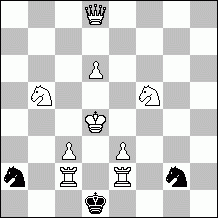
|
1.Qg8 ? 1 ... Sb4! 1.Qa8 ! |
Jubilee tourney Stefan Parzuch - 75

h2# - theme: More solutions with model mates
Twins, fairy pieces and conditions are not allowed.
Award will be ready by July 3rd 2012.
Judge: Stefan Parzuch
Send to : Stefan Parzuch, Wilanowska 6/27, 05-120 Legionowo, Polland
kkszach(AT)interia.pl
Closing date: 31.3.2012
KoBulChess thematic tourney
The website for chess composition http://kobulchess.com announces its first Thematic Tourney in the following sections:
A: Direct #/=, H#/=, S#/= or HS#/= in 2-3 moves with white, black or white and black KoBul King without any other fairy conditions or pieces.
B: Direct #/=, H#/=, S#/= or HS#/= in 2-3 moves with white, black, white and black or neutral KoBul King in combination with other fairy pieces (but only if the problem can be computer tested - for now only WinChloe can be used). Fairy conditions are not allowed.
Definition of KoBul King:When a piece (not a pawn) of his own side is captured, a King transforms into a Royal piece of the same type as the captured one. When the King is in the form of any Royal piece and there is a capture of one of the pawns of his own side, he becomes a normal King again. Captures are illegal if they result in self-check by the transformed King. Castling is allowed only if the KoBul King is on his initial square in the form of a normal King and if he has not already moved; however he may already have been transformed.
Prizes: books and diplomas
Judge: Diyan Kostadinov
Send to: dkostadinov(AT)abv.bg
The results will be published in http://kobulchess.com website in May 2012
Closing date: 31.3.2012
Examples:
|
Diyan Kostadinov A:WCCC Crete 2010 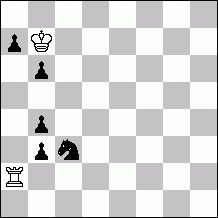 h2# 2+5 B: Pa7 -> b2 c3 - Royal Knight KoBul Kings 1.b5 Ra4 2.rS:a4(wK=rR) rR:a7(brS=K)# B: 1.rS:a2(wK=rR) rR:b6(brS=K) 2.Ka3 rRa6# |
Kostas Prentos
1.Qf6+ S:f6(bK=rQ) 1st Bulgarian Wine Tourney WCCC 2010 1st-3rd Prize 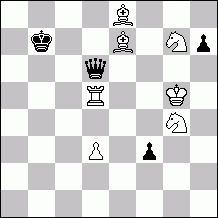 h#2 7+4 KoBul Kings 2.rQ:e7(wK=rB) S:h7(brQ=K)# (2...Sd7??) 1.Qe5+ S:e5(bK=rQ) 2.rQ:d5(wK=rR) S:f3(brQ=K)# (2...Sc6??) |
Diyan Kostadinov
1.nrSf4? nrSe6 Problem Paradise 2010 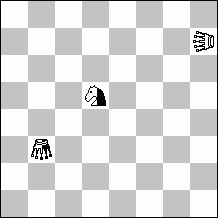 h#2 1+0+2 KoBul Kings d5 – neutral Royal Knight b3 – neutral Grasshopper h7 – Locuste 2.nGf7 Lxf7-e7(nrS=nrG)+ 3.nrGe8! 1.nrSb6? nGb7 2.nrSa4 Lxb7-a7(nrS=nrG)+ 3.nrGa8! 1.nGe6! nrSf6 2.nGg6 Lxg6-f5(nrS=nrG)# 1.nrSc3! nGd3 2.nrSe2 Lxd3-c2(nrS=nrG)# |
Memorial tourney Boujema Kariouch
h2-7# - theme free
Judge: Christer Jonsson
Send to : Abdelaziz Onkoud , 08 François Villon , n° 2362, 93240 Stains, France
azonkoud(AT)hotmail.com
Closing date: 31.3.2012
Memorial tourney Milu Milescu - 100
"EG" announces a special composing tourney for human studies to commemorate the 100 anniversary of Milu Milescu (11.11.1911- 6.11.1981) a Rumanian originated Israeli promoter of the art of the endgame study and International judge for chess composition. In Rumania he was for many years the editor-in -chief of the Revista Română de ?ah and later he ran in leading magazines (such as Europe Echecs , Deutsche Scachzeitung and the Israeli monthly Shahmat) popular and highly instructive columns regarding the linkage between chess composition and the realm of over the board chess. In 1962 he published the book Sigmund Herland: Problemes Choisis and with Dr. Hans-Hilmar Staudte he wrote the best seller Das 1x1 des Endspiels
Judge: Amatzia Avni
Book prizes, honourable mentions and commendations will be awarded. No set theme.
Original human studies (not more than three per composer) should be sent (preferably by e-mail) on diagrams with full solutions and postal address to the tourney director:
Send to: René Olthof, Achter't Schaapshoofd 7, 5211 MC's- Hertogenbosch, The Netherlands
raja(AT)newinchess.com
Closing date: 31.3.2012
Memorial tourney Romolo Ravarini
“To honour the recent loss of the Italian chess problem composer and solver Romolo Ravarini, his friends through the API (Associazione Problemistica Italiana) and with the support of F.S.I., A.P.I., A.S.I.G.C., A.R.P.A., L’Italia Scacchistica (Sezione Problemisti e Solutori), Best Problems and the Società Scacchistica Novarese announce two Thematic Composition Tourneys, for orthodox direct 2-moves (#2) and orthodox Helpmates in two moves (H#2)”.
2# - Ortodox #2 problems showing, through 2 or more phases, a play centered around a white half-battery. The halfbattery must be active (i.e. effectively firing to give mate, functioning as direct, indirect or masked battery) in the threat(s) and/or in the variation mate(s) in at least 2 phases, and in any case in the solution.
Judge: Marco Guida
h2# - A black piece in the final position, make interference to another black piece, allowing the mate because pinned. Not allowed zeroposition.
Judge: Antonio Garofalo
maximum 3 per author every section
Send to: Vito Rallo, via Manzoni n.162, 91100 Trapani, Italy
rallovito(AT)tin.it
Closing date: 21.3.2012
Examples:
|
Marco Guida
The Problemist 2005 3rd Prize |
|
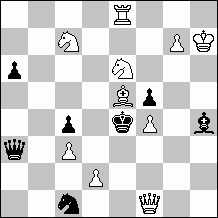
|
1.Bd6-A? (2.Sc5-C/Sg5-D#) but 1... Qxc3-x! [The battery is active in the threat] 1.Bf6-B? (2.Sc5-C/Sg5-D#) but 1... Bf2-y! [The battery is active in the threat] 1.Qh3? (2.Qe3#), Qxc3-x/Bf2-y; 2.Sc5-C/Sg5-D# but Bg3! In this try the battery is not active, since mates are given without an active role of the battery (if the rear rook will not be on the chessboard, this try would work in any case). Solution : 1.Sd4! (2.Qf3#) 1... Qxc3-x/Bf2-y; 2.Bf6-B/Bd6-A# Modern Dombrovskis + Hannelius themes are shown in the Try-play (by means of the double-threat mechanism) and the Banny theme develops in the actual play. “Note also the changes of motives of the thematic defences. In short, a traditional Half-Battery perfectly decorated in modern style (award commentary by Judge P.Robert)”. |
|
2# 10+7
|
|
|
Romolo Ravarini
Sinfonie Scacchistiche 1971 |
|
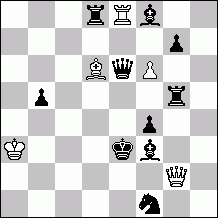
|
a – diagram : 1.Be2 Qd5 2.Qe7 Bc5# b – wSd6 : 1.Rc5 Qc2 2.Qe5 Sf5# |
|
h#2 5+10
B: =wSd6 |
Jubilee tourney Zlatko Mihajloski - 65
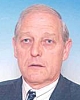
Tourney is announced by The Macedonian Problemist in honour of the 65th birthday (on 15 March 2011) of its regular collaborator and National Master of Problem Chess.
h4# - theme free
Judge: Zlatko Mihajloski
The preliminary award will be submitted by e-mail on 1 May 2012.
Send to: Zoran Gavrilovski, p. fah 137, MK-1001 Skopje, Macedonia
mprobl(AT)yahoo.com
Closing date: 15.3.2012
30th TT Chess Composition Microweb
Chess Composition Microweb announces formal thematical tourney for fairy twomovers (i.e. #2 with at least one fairy element present) showing multiple threat in at least one try or solution.
Any fairy conditions and any fairy pieces are allowed. The tourney might be divided to multiple sections if enough problems are received and depending on the opinion of the judge.
Judge: Juraj Brabec
Send to: juraj.lorinc(AT)bigfoot.com
Closing date: 3.3.2012
Examples:
|
Ladislav Salai jr.
Emil Klemanic 17th TT Spisska Borovicka C 9.9.2005 Honourable Mention e.a. |
Wladyslaw Rosolak
Lipskie Centrum Kultury C 1.9.1999 2nd Commendation |
Petko A. Petkov
feenschach 1979 1st Prize feenschach 2002 |
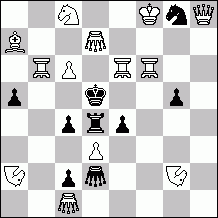
|
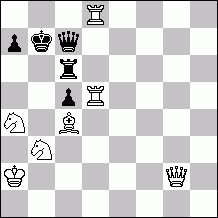
|
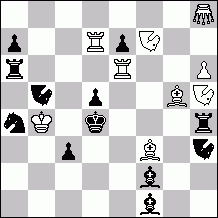
|
|
2#
13+9
|
2#
7+5
Circe |
2#
9+12
|
|
1.Ge3?
(2.RHfd6#A,Sd6#B,RHbd6#C) 1...exd3 a 2.RHfd6# A 1...cxd3 b 2.Sd6# B 1...Rxd3 c 2.RHbd6# C 1...Gf4! 1.Gc3! (2.RHfd6#A,Sd6#B,RHbd6#C 1...exd3 a 2.Sd6# B 1...cxd3 b 2.RHbd6# C 1...Rxd3 c 2.RHfd6# A Lacny cycle. |
1...Rb6, Qd7 2.Sa5#, R5xd7#
1.Ba6+? Rxa6(Bf1)! 1.Sa5+? Qxa5(Sg1)! 1.Sxc5+? Rxc5(Sg1)! 1.Rd7! (2.Ba6#,Sa5#,Sxc5#) 1...a6 2.Bxa6(pa7)# 1...a5 2.Sxa5(pa7)# 1...Qxd7(Rh1) 2.Sxc5(pc7)# |
1.Bf4? (2.Rxd5#, Re4#)
1...Nd6! 1.Nf4? (2.Rxd5#, Re4#) 1...Rd6! 1.Rdd6! (2.Re5#, Ne5#) 1...Rf4 2.Rxd5# 1...Nf4 2.Re4# |
Jubilee tourney Christer Jonsson - 64
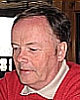
hn# - without wK, promoted pieces are allowed, but not fairy pieces.
Judge: Christer Jonsson
Send to: Rolf Uppström, Godhemsgatan 24 C, SE- 41468 Göteborg, Sweden
rolf.uppstrom(AT)springaren.se
Closing date: 1.3.2012
Jubilee tourney N. Chikanov - 80
h3# - Theme: Play on a pin-line is based on self-pinning of a black piece and unpinning of a white one, the unpinned piece mating on the pin-line. Account will be taken of the harmony of simultaneous black pin creation and white pin elimination. No twins of any form are allowed.
s2# - Theme: Combinations in White’s tries are differentiated on the basis of provision of flights for the white king.
Judge: N. Chikanov
Send to: Yuri Gordian, P.O. Box 66, Odessa-26, 65026, Ukraine
gordian37(AT)mail.ru
Closing date: 1.2.2012
Examples:
|
N. Chikanov
1.Qc6 Qh4 2.Sh3 Qxf6Probleemblad 1996 2nd Prize 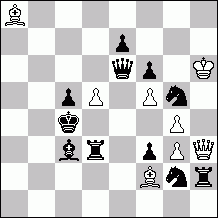 h#3 8+11 3.Kxd5 Qe6# 1.Qe3 Qh5 2.Sh4 Qxg5 3.Kd4 Qf4# |
N. Chikanov
1.Qxc5 ? (Qd5+ exd5#)9th Championat USSR 1976 2nd Place 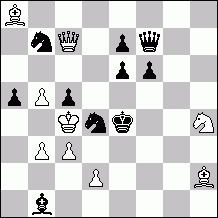 s#2 9+10 1... Sxb5 2.d3+ (Qf5+?) Bxd3# 1... Sxb3 2.Qf5+ (d3+?) exf5# 1 ... a4 ! 1.Qd7 ! (Qd5+ exd5#) 1... Sxb5 2.Qd3+ (Qe6+?) Bxd3# 1... Sxb3 2.Qe6+ (Qd3+?) Qxe6# |
8th Thematic tourney Quartz
The Romanian chess-problem magazine Quartz has dedicated its 8th Thematic Tourney to a new fairy condition: Circé mémoire (Memory Circe). There are two sections (retro and non-retro)
Memory Circe: Any capture triggers the rebirth of the piece previously captured, on the same square where its capture occurred (if it is not occupied), regardless the color or the type of the unit just captured. The reborn piece resumes its normal course. If the square where the capture occurred is occupied, then the captured unit is annihilated. A unit can exist in memory before the actual play starts.
Long Memory Circe: As above, with the following difference: if the rebirth square is occupied, the unit is not annihilated, but instead continues to be kept in memory. (In LMC is thus possible to have two or more pieces being reborn simultaneously!).
Judge: Paul Raican
Send to: Cornel Pacurar tt8quartz(AT)gmail.com
Closing date: 31.1.2012
Examples:
|
P. Rãican & D. Forlot
1.Kxd2 (+bpe3) Kc4 France Échecs 2011 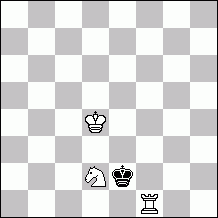 h=2 3+1+1 Memory Black pawn Memory Circe 2.Ke2 Kc3= (Kxf1 ?, +Sd2) 1.Kxd2 (+bpc3) Rb1 2.Kc2 Ke3= (Kxb1 ?, +Sd2) |
P. Rãican
a)France Échecs 2011 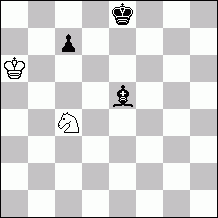 h#3,5 2+3+1 Memory Black rook Memory Circe b) Ka6 -> h5 1...Kb5 2.c5 Kxc5 (+bRa8!) 3.0-0-0 Kc6 4.Bb8 Sb6# b) 1... Kg6 2.c6 Sxe5 (+bRh8!) 3.0-0 Sxc6 (+Be5) 4.Bh8 Se7# |
P. Rãican
a)France Échecs 2011 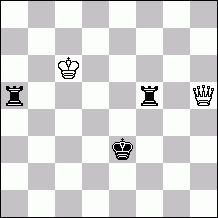 hs#4 2+3+1 Memory Black knight Long Memory Circe b) Rf5 -> d5 c) Rf5 -> e4 1.Qxf5 (+bSg5) Rd5 2.Kxd5 Kd2 3.Ke5 Kc1 4.Qc2+ Kxc2 (+bRd5,+bRf5)# b) 1.Qxd5 Rb5 2.Kxb5(+bSa5) Kf2 3.Kc5 Kg1 4.Qg2+ Kxg2 (+bRb5,+bRd5)# c) 1.Qxa5 Ke2 2.Kb5 Re3 3.Ka4 Kd1 4.Qd2+ Kxd2 (+bRa5, +bSc6)# |
Jubilee tourney Valeriu Petrovici - 80
In a H#2*, the real solutions are succesively validating (and eventually with the same strategic effects) the corresponding setplays. Compulsory the thematic pieces are fairy, but there are not allowed any fairy conditions. First moves of black&white must not be passive (tempo or zugzwang).
Judges: Valeriu Petrovici & Stelian Lamba
Prizes in Romanian problemistic literature.
The results will be announced on 9th February 2012, Valeriu Petrovici's 80th birthday.
Send to: Valeriu Petrovici, P.O.Box 77-09, Bucuresti sector 3, Romania
valeriu.petrovici(AT)gmail.com
Closing date: 31.1.2012
Example:
|
Valeriu Petrovici
Original |
|
|
h2#
6+4
|
|
1... Bb5 2.Gc3 Nf5#
1... Bf5 2.Ge3 Nb5# 1.Ge3 Bb5 2.Gc3 Nf5# 1.Gc3 Bf5 2.Ge3 Nb5# |
Memorial tourney Yakov Smushkevich
2# - theme free - Judge: Vasyl Dyachuk
3# - theme free - Judge: Yakov Rossomakho
h2#, h3# - theme free - Judge: Viktor Zaitsev
s2-10# - theme free - Judge: Petko Petkov
Send to: Vadim Vinokurov vkv-53(AT)yandex.ru
Closing date: 10.1.2012
Jubilee tourney ChessBase - 25
To celebrate the 25th anniversary of ChessBase, the world’s leading chess software company, we are announcing a special composing tourney for endgame studies (win or draw). There are no restrictions on the type of study. ChessBase have generously offered some of their products as prizes. First prize: A copy of the famous Fritz program signed by over-the-board world champions. Special prizes will be awarded to the best composing débutants.
Judge: John Nunn
The tourney director Luc Palmans will only accept entries by Email. Please attach pgn files. The judge’s award will be published on the ChessBase news page by the end of March 2012.
Send to: palmans.luc(AT)skynet.be
Closing date: 31.12.2011
30th Thematic tourney Problem-Echo
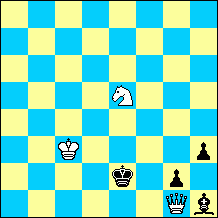
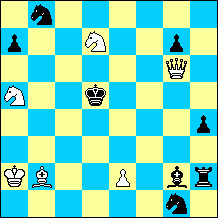
4-6# - Theme: In the initial position each of the eight squares adjacent to the black king is unoccupied. (The black king is not allowed on any square edging the board.)
Judge: Volker Zipf
Send to: Dieter Müller, Grenzstraße 45A, D-10376 Oelsnitz, Germany
Muellerhaupt(AT)aol.com
Closing date: 31.12.2011
Examples:
|
Dieter Müller
JT V.Persiyanov-50 2006 1st Spezial Prize |
Dieter Müller
Volker Zipf JT S.Sacharow - 50 2002 2nd Prize |
|
|
|
6#
3+4
|
4#
6+8
|
|
1.Qh2 ? Ke3 !!
1.Kc2 ! 1... h2 2.Qd1+ Ke3/Kf2 3.Qf3+ Kd4/Kg1 4.Sd7/Qd3 Kc4/Kf2 5.Qb3+/Sg4+ 6.Qd3/Qd1# |
1.Ka1 ! (2.e4+ Bxe4 3.Qf7+
Kd6 4.Be5#) 1... Sxe2 2.Qf7+ Ke4 3.Sc5+ Ke3 4.Sc4# |
The internet thematic tourney - 2011
The Commission of Chess Composition of Georgia announces an annual thematic Internet tournament for a studies.
The theme - a mutual zugzwangs in a main line and thematic try . Thus, the zugzwangs should be realized in positions with more than 6 chess man. Is required at least one zugzwangs in each phase.
Are nominated prizes, honorable and commendation mentions.
Editor and judge - Iuri Akobia
The original studies which will be selected - periodic will be published in the website: http://akobia.geoweb.ge
The preliminary award can see on 12.02.2012 in the same website.
All remarks regarding the published studies should be sent to the address of judge: akobia(AT)geo.net.ge
Send to: akobia(AT)geo.net.ge
Closing date: 30.12.2011